Project Vision
Across the Atlantic world, democratic social practices and standards of governance are under sustained attack. Linked authoritarian movements in Europe, Africa, Latin America, North America, and the Caribbean are actively undermining democratic institutions and civic norms—often in the name of defending national identity and Christianity. In this process, Christian theology is not only invoked but reinterpreted to justify brutal, demeaning policies, and the erosion of pluralistic democratic life.
One expression of this dynamic is the rise of rhetoric such as “toxic empathy,” alongside excluding strangers and enemies from love of neighbor. Another is the denial that all humans, as those made in the image of God and regardless of identity or capacity, bear equal dignity. These developments are not incidental.
The result is a profound distortion: Christianity is increasingly mobilized in the service of hyper-individualism, ethno-religious nationalism, civilizational chauvinism, and new forms of authoritarianism. At a time when democracies are under severe strain, the question is not only how to defend democratic institutions, but how to renew the moral, intellectual, spiritual, and social foundations that sustain them and what role Christianity, along with other religions, can play in their renewal.
Origin and Opportunity
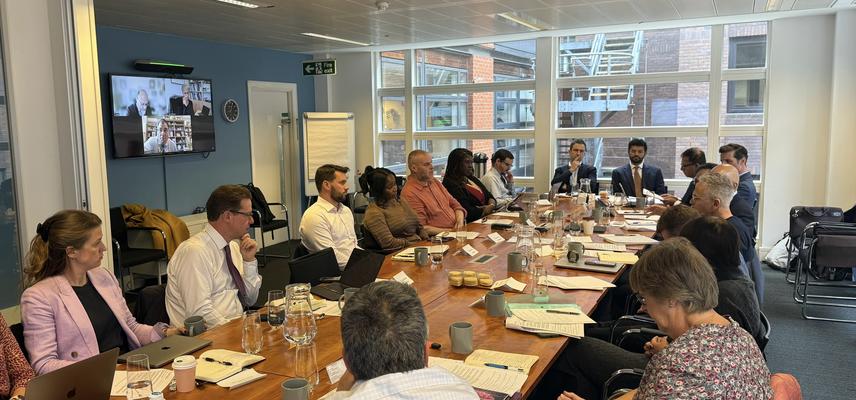
The latter question—renewing democracy’s moral, intellectual, and communicative foundations—took center stage at the December 2024 convening In a Time of Zozobra: Religious Traditions and Democratic Flourishing, held at Christ Church, University of Oxford. Jointly convened by the Institute for Advanced Catholic Studies at the University of Southern California and the McDonald Centre for Theology Ethics and Public Life at the University of Oxford, the convening brought together scholars, practitioners, and institutional leaders across disciplines and continents.
The gathering demonstrated both urgency and possibility: urgency in the face of coordinated anti-democratic movements, and possibility in the depth of intellectual, theological, and practical resources available across Christian traditions and beyond. Participants emphasized that the challenge is not simply political, but cultural and formative—shaping how people understand agency, community, authority, the common good, and the Christian faith itself.
This project builds on that foundation. It envisions a sustained, transnational effort to reclaim and re-energize Christianity’s role in contributing to democratic life, while building a broader coalition committed to pluralism, human dignity, and the renewal of just and generous forms of common life.
The project builds off a key strand of modern Christian moral and political thought and practice that responded to parallel moments of political crisis. Central to these responses was the refusal of divisive frames of reference and the advocacy of democratic means of addressing shared problems. This theological vision is witnessed and articulated in the work of Dorothy Day and the Catholic Worker movement in the 1930s as they sought an alternative to militarism and dehumanising forms of industrial capitalism; theologians and philosophers such as Jacques Maritain, Reinhold Niebuhr, Karl Barth, and Archbishop William Temple writing defences of democracy in response to the rise of fascist and communist totalitarianism in the 1940s; Léopold Sédar Senghor’s critique of colonialism and advocacy of African self-determination in the 1950s; Dorothy Cotton, Fannie Lou Hamer, Bayard Rustin, and Martin Luther King, Jr.’s advocacy of beloved community as the alternative to white supremacy and Jim Crow laws in the 1960s; Latin American liberation theologians such as Gustavo Gutiérrez and Oscar Romero’s struggles against dictatorships and exploitative forms of political economy in the 1970s; Archbishop Desmond Tutu’s account of ubuntu as the basis for a democratic political order in the context of apartheid and post-apartheid South Africa in the 1980s and 90s; and Pope Francis’s restatement of Catholic social teaching in response to climate change and mass migration today.
Why Now
Many current efforts to counter authoritarianism focus on policy, elections, or institutional safeguards. These are necessary but insufficient. The rise of authoritarianism is not only a political challenge—it challenges broader public narratives, frameworks of meaning, social identity, and moral imagination. Efforts to address it must therefore extend beyond policy and into the deeper cultural, spiritual, and intellectual foundations of democratic life.
Christian institutions, ideas, and communities remain among the most powerful—and contested—forces shaping those foundations across the Atlantic world. This project offers a way to engage that reality constructively: to renew resources within Christian traditions that proclaim that all are made in the image of God and committed to pluralism as a moral good.
Geographic Focus: The Atlantic World
Drawing on Paul Gilroy’s concept of the Black Atlantic, the project focuses on the Atlantic world—Europe, North America, the Caribbean, Latin America, and Africa. This geographic scope enables grounded, comparative analysis while avoiding both abstraction and parochialism. It also reflects the reality that religious and political dynamics are deeply interconnected across these regions, through diasporic communities, institutional ties, and shared cultural reference points.
Core Aim
The project has two integrated aims:
- Build a transnational coalition of centers, institutes, think tanks, and public platforms dedicated to examining and promoting constructive accounts of Christianity’s role in democratic life
- Develop and disseminate intellectual and practical resources—drawing from theology, social science, and lived experience—that strengthen democratic culture and civil society