Call for Papers: Political Theologies of Tradition and Rootedness
Political Theologies Conference 2027
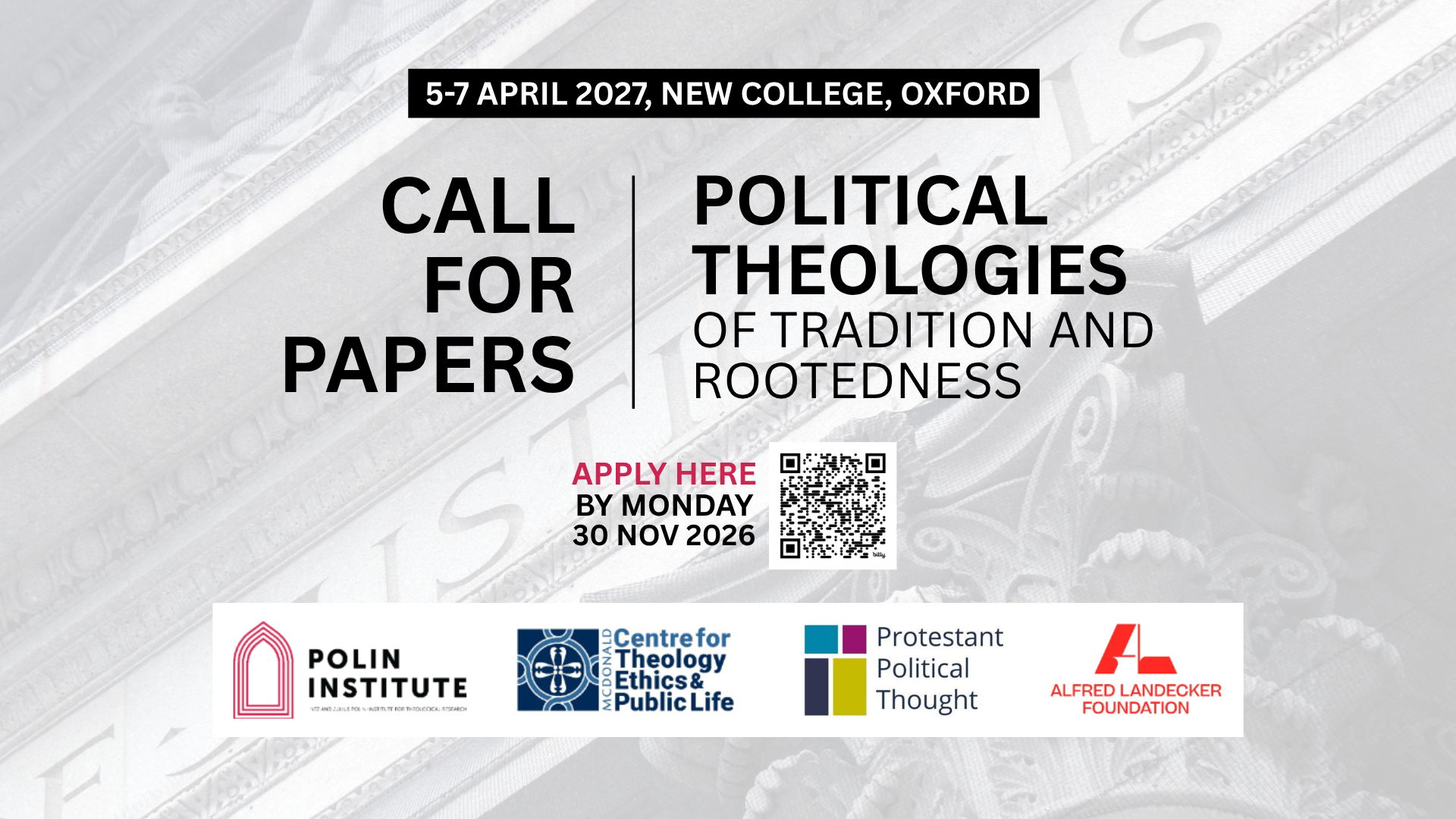
The seventh Political Theologies conference, to be held at New College, Oxford from the 5-7 April 2027, invites reflection on the significance of tradition(s) and rootedness as mediators of the past, the present and the future. How does political theology engage and contest tradition? How does political theology shape beliefs, practices and imaginaries of tradition, and how it is shaped by it in turn? What makes tradition significant, useful or problematic as a source of community and as a source of knowledge? What is the significance of tradition in the context of democratic resilience and geopolitical transformations?
Practices of historical retrieval and ressourcement can help to interpret and illumine our current moment and afford ways of imagining otherwise. Yet appeals to history and tradition can also serve to confer authority on selective accounts of the past, silence countervailing memories and experiences, and narrow the range of political possibilities in the present. Appeals to tradition, therefore, are sites of political agency, capable of sustaining civic renewal and animating shared pursuit of the common good, but also of legitimating reaction, exclusion, and domination.
Key questions to be explored include:
• What practices of retrieval, reconstruction, or immanent critique might contribute to the renewal of contemporary political life?
• What alternative histories of the intersection of religion and politics need to be recuperated or told afresh?
• Which neglected traditions, marginal voices, or ways not travelled invite renewed attention?
• What new traditionalisms and futurisms are being constructed in our time, by whom, and to what ends?
• What stories have been told – and should now be told – about democracy, including its fragility, resilience, and conditions for flourishing?
• What kinds of political agency are exercised through claims of traditional authority? How are precedents and resource from the past selected, interpreted, included or omitted?
• What is involved in the political theology of collective memory, or practices of remembering and forgetting?
Paper proposals and panel suggestions are invited from scholars in theology and religious studies, political theory, politics, sociology, anthropology, law, history, and philosophy, among other relevant disciplines. We welcome papers exploring these questions from a range of geographical, cultural, religious, or ecumenical contexts as well as from normative, descriptive, and critical standpoints.
Please submit a proposed paper title, short abstract (c. 200 words) and short biography to this form (bit.ly/political-theologies-27) or via the QR code below, by 30 November 2026. We aim to release decisions by 22 December 2026. Short conference briefs of ca. 2,000 words are due by 15 March 2027.
Associated events
Any graduate students applying for the conference may also be considered for the Postgraduate Pre-Conference in the morning of 5 April 2027.
A college dinner will be hosted on the evening of 6 April 2027. The dinner will be included as an optional item at registration and is open to speakers and attendees of the conference.
Funding and embedding
A limited number of travel bursaries may be offered to speakers, strictly based on need. Cost of travel will only be considered in exceptional circumstances and applicants must make a strong case that no other funding is available to them. All requests for bursaries must be submitted over email to politicaltheologies@divinity.cam.ac.uk by 30 November 2026. Requests for support will not affect the selection process.
This conference is generously funded by the Landecker Foundation, McDonald Centre for Theology, Ethics, and Public Life at the University of Oxford, the Inez and Julius Polin Institute for Theological Research and the Chair in Public Theology and Ethics at the VU Amsterdam.
The Political Theologies conference series grew out of the Protestant Political Thought project, hosted at the Blavatnik School of Government, Oxford and continues as part of the Landecker Lectureship ‘Imagining Sacred Lands’ at the University of Cambridge. This project has featured a series of workshops and conferences, many of which have led to collaborative publications, including in The Journal of the Bible and its Reception (2021), Religion, State, Society (2022), as well as the edited collection The Many Faces of Christianism: The ‘Russian World’ in Europe (2025).
For more information, email to politicaltheologies@divinity.cam.ac.uk, Marietta van der Tol at mdcv2@cam.ac.uk, or Sam Tranter at samuel.tranter@theology.ox.ac.uk